Mahé of Malabar

The history

Pepper, forts and a river

The ground the book stands on: a small country on the Malabar coast, the two companies that came to it, and the dates that shaped it.

The coast

Where the pepper came down to the sea

The pepper vine climbs the coral tree, the mango, the jackfruit and the areca palm, and the monsoon feeds it. Its berries were picked green and dried black and carried down to the shore to be sold. Greeks and Romans came for it on the monsoon wind and went home on it. Arab traders came and stayed. Then the Portuguese came, and after them the Dutch, the French and the English, each on the same wind with the same errand.

A company's merchant came first as a guest and asked the lord of the shore for a little ground. The shop became a factory, the factory a warehouse, the warehouse wanted soldiers, the soldiers wanted walls, and the walls became a fort. The largest berries of that coast still go to market under the English name of the port, Tellicherry.

"It is quite surprising that the use of pepper has come so much into fashion … and yet it is for this that we import it all the way from India!"Pliny the Elder, Natural History, Book 12
The places

The country between the forts

Courchy

the seat of the house

On the shore between the two forts, where the Kurangoth Nayar's small fort stood a stone's throw from the family house.

Punnol

half a mile up the shore

Where the grant of May 1702 let the French settle and trade in the Kurangoth country.

Mahé

Mayyazhi · the French comptoir

Founded by the Compagnie des Indes in 1721 on the south bank of the river, facing the Kurangoth country across the water.

Tellicherry

Thalassery · the English fort

The East India Company's factory and fort, four miles up the coast from Mahé.

Calicut

Kozhikode

The great port to the south, and the seat of the powers that came down on Malabar from Mysore.

The manji

the boat of the coast

The one-masted sailing boat of the Mappila boatmen, which carried rice and pepper from port to port.

A short ledger of datesfrom the companies' papers

The century in dates

1702The grant of Punnol. A Kurangoth Nayar lets a French company settle and trade on his ground and promises it his protection.
1719The English take a strip of the Kurangoth country below their fort at Tellicherry.
1721The Compagnie des Indes founds its comptoir at Mahé, across the river from the Kurangoth country.
1725Kunjunni Nayar puts his person and lands under French protection to recover the country the English had taken.
1738The Peringatour Convention.
1751Kunji Nayar takes up the office he will hold for thirty-six years.
1766Hyder Ali comes down on Malabar. The Kurangoth Nayar does homage at his camp beside the French, and pays for it with an elephant.
1775Hyder comes again. The French at Mahé bend, and the bending is done on the Kurangoth Nayar's land.
1778Bellecombe's Règlement takes half the house's revenue for a French administrator.
178724 September. On a festival day, with his Nayars away, Kunji Nayar is taken from his house at Courchy and carried south by boat toward Calicut.
1793Mahé falls to the English, and the white flag comes down for the last time in the book's century.
1806The house is a name on a compensation roll, drawing Rs 1,427-12-9 a year from the Company that took the land.

What happened to Kunji Nayar after the boat left Courchy is told in the book.

The flag

Which flag flew at Mahé

From 1721 the comptoir at Mahé flew the white flag of the Bourbon Crown, the same flag the Compagnie des Indes carried at Pondichéry and its other posts. In everyday use it was plain white. The royal version was sown with gold fleurs-de-lis, the form shown on this site.

The tricolour belongs to the Revolution. From 1790 French ships flew a white ensign with a small tricolour in its upper corner, and the familiar blue, white and red came in 1794, by which time Mahé had fallen to the English. For almost all of the French years at Mahé, the flag over the river was white.

The two forts, and the country today
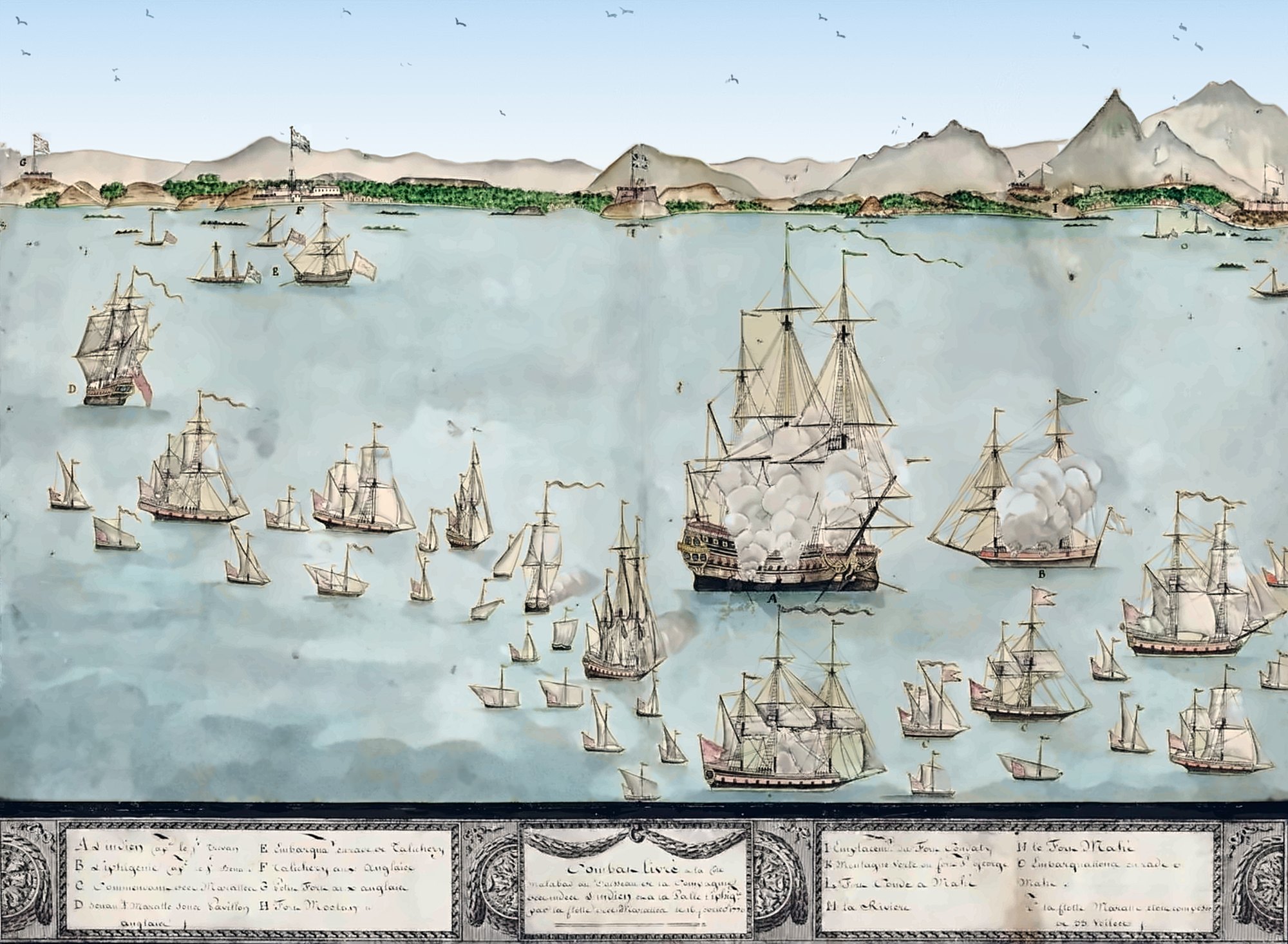
Eighteenth-century French drawing of a sea fight off the Malabar coast: a Compagnie des Indes ship and a smaller vessel under fire from a fleet of Maratha sailing craft, with Tellicherry, Fort Moilan and Mahé on the shore below the hills
Off Mahé, 16 February 1770. The Compagnie des Indes ship L'Indien and the palle Iphigénie fight off a Maratha fleet of fifty-five sail, with the English at Tellicherry and the French forts at Mahé looking on from the shore. Combat livré à la côte Malabar au vaisseau de la Compagnie des Indes L'Indien et à la Palle l'Iphigénie par la flotte des Marattes le 16 février 1770. Source gallica.bnf.fr / Bibliothèque nationale de France
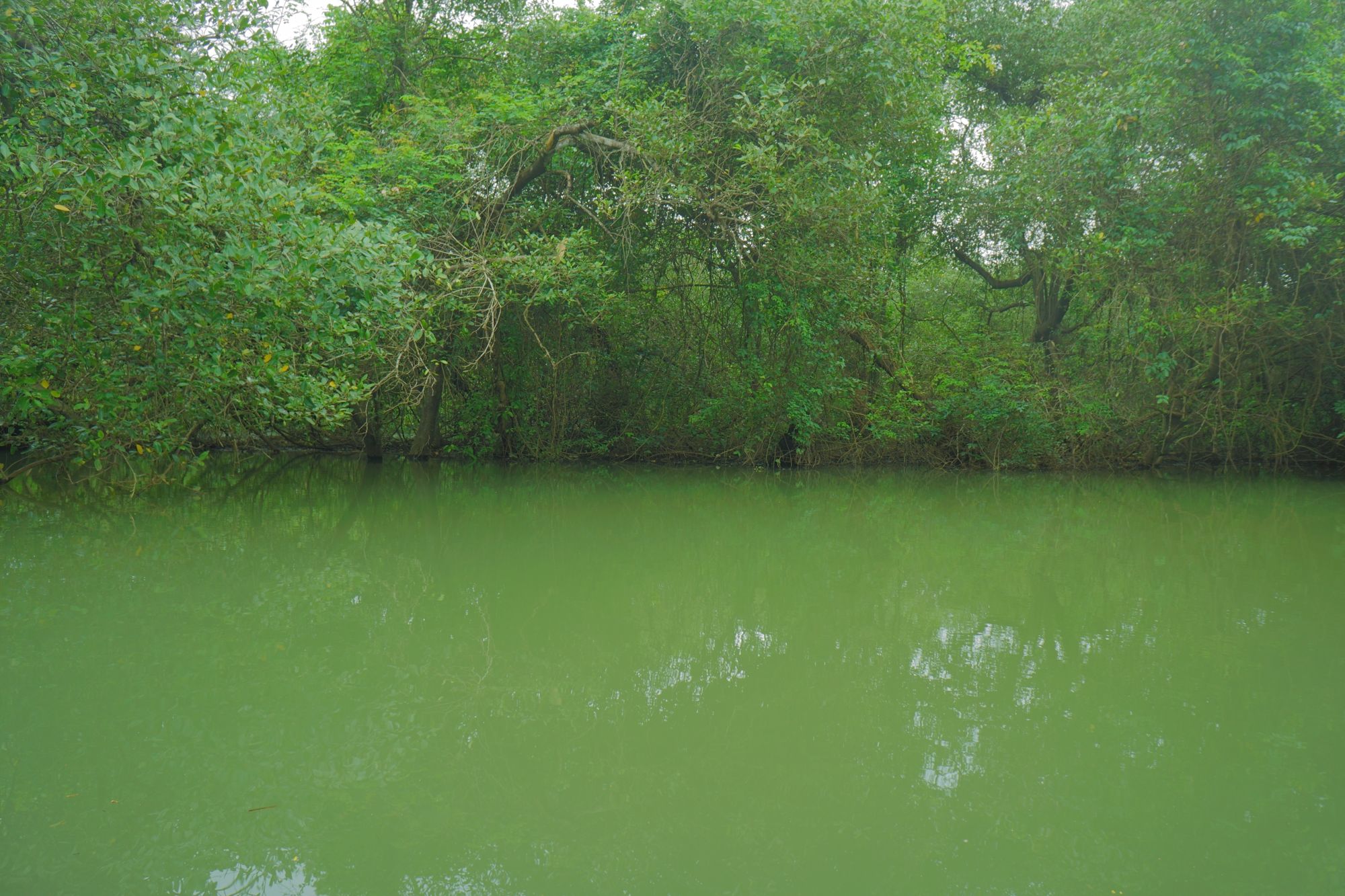
Still green water under a dense bank of trees and creepers
The papers

Where the story is kept

The French side of the story survives in the colonial archives at Aix-en-Provence and in the catalogues of the Pondichéry records. The English side survives in the Tellicherry Consultations and the reports of the Joint Commission of 1793. Alexander Hamilton, Pierre Sonnerat, William Logan's Malabar Manual and Alfred Martineau's Les Origines de Mahé de Malabar (1917) fill in the rest.