Mahé of Malabar

A narrative history · 1702 to 1806

The Coringattenaïrs of Malabar

For a hundred years one small Nair house held the shore between an English fort and a French one. The companies dealt with it, taxed it, protected it and pensioned it off, and almost never wrote down its lords' names.

The white flag of the French Crown, sown with gold fleurs-de-lis
The white flag of the French Crown, sown with fleurs-de-lis. It flew over the comptoir at Mahé from its founding in 1721, between the English occupations of 1761 and 1779, until the post fell for good in 1793. The tricolour as we know it never flew over French Mahé.
One house, as the clerks of two companies wrote it CurringhodaCoringoteCorringotte nairCoyonnaireCoringotCorringotte-NairCoringottaCoringattenaïrand in its own country, Kurangoth
Courchy, on the shore between the two forts

A lordship between two flags

In May 1702, at Punnol, a Kurangoth Nayar set his name to a grant that let a French company settle on his ground and trade in his country. The French had come for pepper, as the English had come before them, and as the Portuguese and the Dutch had come before the English.

What followed was a century in which the house kept its country by letters, rice, homage and the gift of an elephant, while the merchants across the table slowly became the men who kept the land. Five men held the office in that time. Four of them fought. One inherited in exile.

The book tells their story from the papers the companies kept: the Tellicherry Consultations, the letter-books of Mahé, the correspondence that went home to Pondichéry and Paris. Nothing in it is invented. Everything between quotation marks was written or said.
Read more about the book

The shape of the book
1702 – 1738

Part One

Whether a small lord can keep his dues, his hills and his pepper against a trading company with a fort.

1739 – 1787

Part Two

Whether a chief can survive between two European posts and a conqueror by writing letters.

1787 – 1806

Part Three

Whether a house without a country can come home, and what it is given instead.

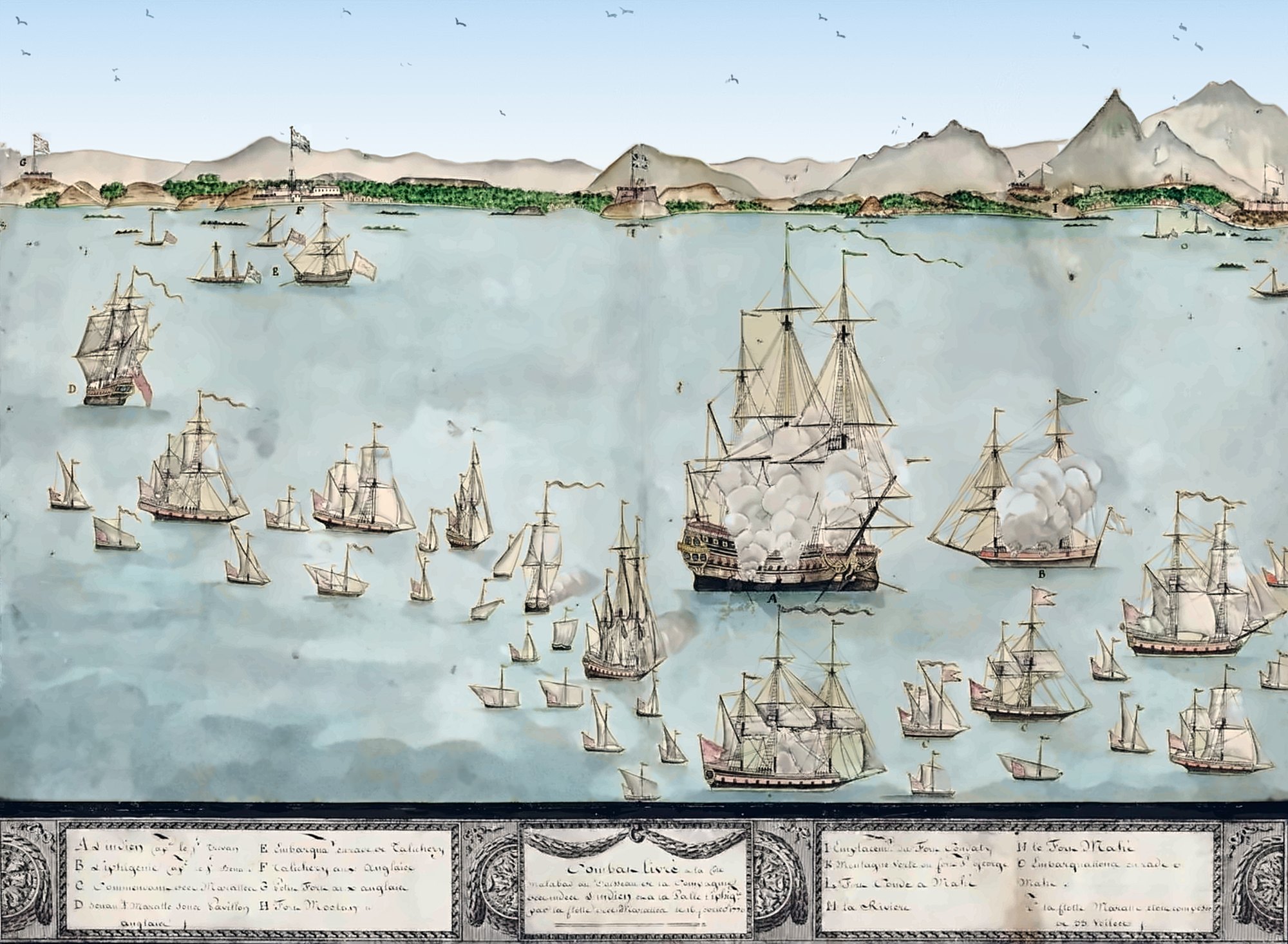
A sea fight off Mahé, 1770

Eighteenth-century French drawing of a sea fight off the Malabar coast: a Compagnie des Indes ship and a smaller vessel under fire from a fleet of Maratha sailing craft, with Tellicherry, Fort Moilan and Mahé on the shore below the hills
Off Mahé, 16 February 1770. The Compagnie des Indes ship L'Indien and the palle Iphigénie fight off a Maratha fleet of fifty-five sail, with the English at Tellicherry and the French forts at Mahé looking on from the shore. Combat livré à la côte Malabar au vaisseau de la Compagnie des Indes L'Indien et à la Palle l'Iphigénie par la flotte des Marattes le 16 février 1770. Source gallica.bnf.fr / Bibliothèque nationale de France